
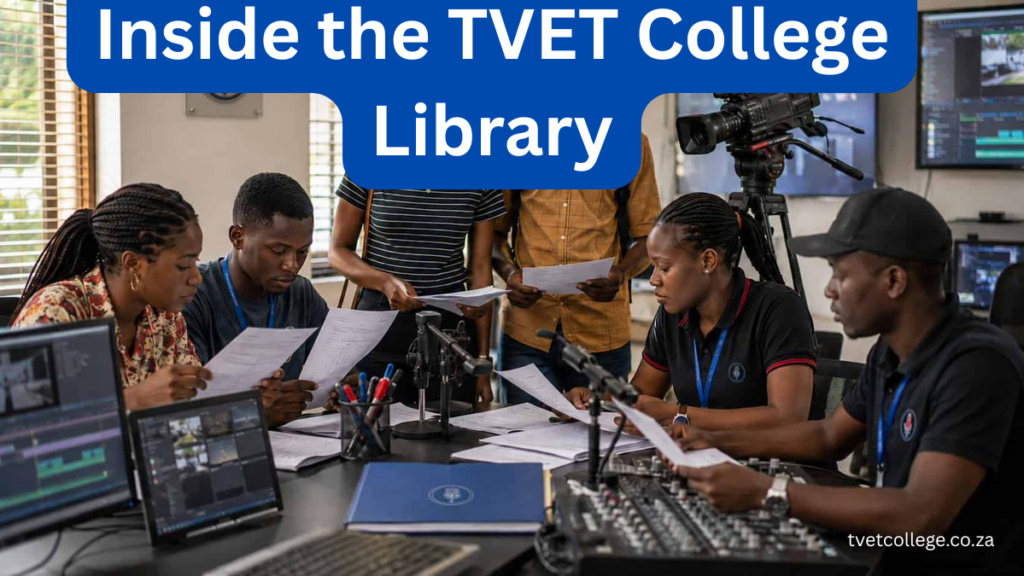
What students should know about all that is inside the TVET college’s library. In this article, I will share with you from my experience what you will find inside the TVET College Library, and everything students should know about how the library will help you in your academics.
When most students think about life at a TVET college, they usually picture classrooms, engineering workshops, computer laboratories, practical training, assignments, and examinations. The college library is often overlooked, especially by first-year students who may assume it is simply a quiet room filled with textbooks.
In reality, a good college library can become one of the most useful resources available during your studies.
Whether you are studying Engineering, Business Management, Information Technology, Hospitality, Tourism, Finance, Office Administration, Agriculture, or another vocational programme, the library can support your academic progress in several ways. It can provide access to learning materials, research resources, study spaces, computers, and guidance that may make completing assignments and preparing for examinations much easier.
For students who do not have reliable internet access, a quiet place to study, or enough money to purchase every recommended textbook, library resources can be particularly valuable.
However, many students never take full advantage of what their college library offers.
Some visit only when they need a textbook. Others enter the library for the first time shortly before examinations. A few students may not even know how to search for books, use digital resources, or ask library staff for assistance.
This guide explains everything students should know about using a TVET college library effectively. Because facilities and rules differ between colleges and campuses, the exact services available at your institution may vary. However, the practical advice in this article can help you understand what to expect and how to make better use of the resources available to you.
What Is the Purpose of a TVET College Library?
A TVET college library is designed to support teaching, learning, research, and independent study.
Unlike a public library, which serves the wider community, a college library usually focuses on the academic needs of students and staff.
Its resources may be selected to support programmes offered by the institution, including subjects related to:
- Engineering
- Business Studies
- Information Technology
- Hospitality
- Tourism
- Finance
- Office Administration
- Agriculture
- Management
- Vocational and occupational training
The library is not intended to replace your lecturers or classroom learning. Instead, it provides additional resources that can help you understand your subjects more deeply and study independently.
Why the Library Matters More Than Many Students Realise
One of the biggest changes when moving from high school to college is the amount of responsibility you have for your own learning.
Your lecturer may introduce a topic during class, but you may still need to:
- Read additional material.
- Research an assignment.
- Prepare for an assessment.
- Review a difficult concept.
- Find information for a project.
- Study independently.
The library can help with all of these activities.
Students who learn how to use library resources early may find it easier to complete academic tasks throughout the year.
Instead of waiting until an assignment deadline is approaching, you can develop the habit of researching and studying consistently.
What Can You Find in a TVET College Library?
The resources available vary from one institution and campus to another. Larger campuses may have more extensive collections, while smaller campuses may offer a more limited selection.
Depending on your college, you may find:
Textbooks
Libraries may provide textbooks related to programmes offered at the campus.
This can be particularly helpful when a recommended textbook is expensive or difficult to find.
However, the number of copies may be limited. During busy periods, such as before examinations, popular books may be in high demand.
This is one reason students should avoid waiting until the last minute to borrow important materials.
Reference Books
Reference materials may include:
- Dictionaries
- Encyclopedias
- Technical manuals
- Handbooks
- Industry guides
- Subject-specific reference books
Some reference materials may only be used inside the library, depending on the institution’s rules.
Newspapers and Periodicals
Some libraries may provide newspapers, magazines, journals, or other publications.
These resources can help students stay informed about developments in:
- Business
- Technology
- Employment
- Engineering
- Government
- The economy
Current information can also be useful when completing assignments that require examples from the real world.
Digital Resources
Modern college libraries are increasingly connected to digital learning.
Depending on the institution, students may have access to:
- Electronic books
- Online databases
- Digital journals
- Past learning materials
- Online research tools
- Institutional learning platforms
Ask library staff which digital resources are available and whether you can access them from home or only while on campus.
How to Register With the Library
Being a registered student does not always mean you can immediately borrow books.
Some colleges may require students to complete a separate library registration process.
You may need:
- A valid student card
- Your student number
- Proof of registration
- Additional information requested by the library
Once registered, you may be allowed to borrow materials according to the institution’s rules.
Ask about:
- How many books you can borrow.
- How long you can keep them.
- Whether renewals are allowed.
- What happens if a book is returned late.
- What happens if a book is lost or damaged.
Understanding these rules early can help you avoid unnecessary problems.
Understanding the Library Catalogue
A library containing hundreds or thousands of books would be difficult to use if students had to search every shelf manually.
This is why libraries organise their collections.
Some libraries provide a digital catalogue that allows students to search by:
- Book title
- Author
- Subject
- Keyword
- ISBN
Once you find the book you need, the catalogue may provide information showing where it is located.
If you do not understand the system, ask a librarian for help.
Learning how to search the catalogue can save a significant amount of time throughout your studies.
Librarians Can Help You More Than You Think
Some students feel uncomfortable asking librarians questions.
There is no reason to feel embarrassed.
Library staff may be able to help you:
- Find a textbook.
- Locate information on a particular topic.
- Understand how the library catalogue works.
- Access available digital resources.
- Learn basic research techniques.
- Understand borrowing procedures.
Instead of spending an hour searching unsuccessfully for something, asking for guidance may solve the problem much faster.
Learning how to ask for help is an important academic skill.
Borrowing Books: What Students Should Know
Borrowing rules vary between colleges, so always follow the policies of your own library.
When borrowing a book, pay attention to the return date.
A useful habit is to:
- Record the due date in your phone.
- Add it to your calendar.
- Set a reminder several days before the deadline.
Do not lend a library book borrowed in your name to someone else unless the library’s rules specifically allow it. If the book is lost or damaged, you may still be responsible for it.
Treat borrowed materials carefully.
Avoid:
- Writing inside books.
- Removing pages.
- Damaging covers.
- Exposing books to food or liquids.
Library resources are shared by many students. Returning them in good condition allows others to use them too.
What Happens If You Return a Book Late?
The consequences of returning a book late depend on your college’s library policy.
Possible consequences may include:
- Fines
- Temporary suspension of borrowing privileges
- Restrictions until the book is returned
Do not assume the rules are the same at every TVET college.
If you know you cannot return a book on time, contact the library and ask whether renewal is possible.
Ignoring the problem may make it worse.
Using the Library as a Study Space
For many students, the most valuable thing about the library is not a book. It is having a quiet place to concentrate.
Studying at home can be difficult.
You may face:
- Noise
- Family responsibilities
- Visitors
- Television
- Social media distractions
- Limited space
A library can provide a more structured environment for studying.
When you enter the library with a specific goal, such as completing two chapters or preparing for a test, you may find it easier to remain focused.
How to Study Effectively in the Library
Simply sitting in a library does not automatically make you productive.
You still need a plan.
Before beginning a study session, decide what you want to accomplish.
For example:
Less effective goal: “I am going to study Engineering.”
Better goal: “I am going to revise two sections and complete five practice problems.”
Specific goals make it easier to measure your progress.
You can also divide your study session into focused periods with short breaks.
During study time:
- Put your phone on silent.
- Avoid unnecessary social media use.
- Keep only the materials you need on the desk.
- Begin with a clear task.
- Take short breaks when necessary.
The goal is not to spend the longest possible time in the library. The goal is to use your time effectively.
Computer Access in the Library
Some TVET college libraries provide computers for students.
These may be useful for:
- Research
- Typing assignments
- Accessing learning platforms
- Reading digital materials
- Checking academic communication
Computer availability may be limited, especially during busy periods.
If your campus uses a booking system, learn how it works early.
Always save your work regularly.
Where permitted, consider keeping copies in:
- Cloud storage
- Your email
- A USB drive
Do not leave your only copy of an important assignment on a shared computer.
Internet and Wi-Fi Access
Internet access has become an important part of modern education.
Depending on the college and campus, the library may provide internet or Wi-Fi access for academic purposes.
This can help students who have limited mobile data at home.
However, college internet should be used responsibly.
Prioritise:
- Research
- Assignments
- Learning platforms
- Academic communication
Spending your entire library session watching unrelated videos or scrolling through social media defeats the purpose of having access to an academic resource.
How to Research an Assignment Properly
One of the most important skills students can develop is the ability to find reliable information.
A common mistake is to search a question online and copy the first answer that appears.
Good research requires more effort.
Start by understanding the assignment question.
Identify the main keywords.
Then search for information using available resources such as:
- Textbooks
- Academic databases
- Government publications
- Reputable educational websites
- Industry publications
Compare information from multiple sources where appropriate.
Ask yourself:
- Who published this information?
- When was it published?
- Is the information still current?
- Is the source relevant to my assignment?
- Can the claims be verified?
These questions can help you avoid unreliable information.
Avoiding Plagiarism
Researching information does not mean copying someone else’s work and presenting it as your own.
Plagiarism may include:
- Copying text without acknowledgement.
- Submitting another student’s work.
- Copying an online article.
- Using someone else’s ideas without appropriate attribution where required.
Your college may have specific rules about referencing and academic integrity.
Learn those rules early.
When completing an assignment, aim to understand the information and explain it in your own words while acknowledging sources according to your institution’s requirements.
Using AI Tools Responsibly
Artificial intelligence tools can support learning, but students should use them carefully.
AI may help you:
- Understand a difficult concept.
- Generate study questions.
- Organise ideas.
- Improve grammar.
- Create a revision plan.
However, submitting AI-generated work as your own without following your college’s academic rules may create problems.
AI can also produce incorrect or outdated information.
Always verify important facts using reliable sources.
Your goal should be to use technology to improve your understanding, not to avoid learning.
The Library During Examination Season
Libraries often become much busier before tests and examinations.
Students who rarely visit during the semester may suddenly begin looking for:
- Textbooks
- Study spaces
- Computers
- Revision materials
This can create competition for limited resources.
A better strategy is to use the library consistently throughout the academic year.
If you need a popular textbook, do not wait until the week before an examination to look for it.
During examination season:
- Arrive early where practical.
- Bring the materials you need.
- Create a study plan.
- Respect other students.
- Avoid unnecessary noise.
Library Etiquette
A shared study environment only works when everyone behaves respectfully.
Basic library etiquette includes:
- Keeping noise levels low.
- Putting your phone on silent.
- Following food and drink rules.
- Treating books carefully.
- Respecting staff and other students.
- Keeping shared spaces clean.
- Following computer usage policies.
A library is not always completely silent, especially if it has designated group-study areas, but students should respect the purpose of each space.
Group Study Versus Individual Study
One of the advantages of studying at a college library is that it may provide an environment for both individual and group learning, depending on the facilities and rules of the campus.
Some students learn best alone. Others understand difficult topics more easily when discussing them with classmates.
Neither method is automatically better. The right approach depends on the task you are completing.
When Individual Study Works Best
Studying alone may be more effective when you need to:
- Read a difficult chapter.
- Memorise important information.
- Write an assignment.
- Prepare personal notes.
- Complete calculations.
- Concentrate without interruption.
Individual study allows you to work at your own pace.
When Group Study Can Help
Group study can be useful when you want to:
- Discuss difficult concepts.
- Compare notes.
- Practise examination questions.
- Prepare for presentations.
- Work on group assignments.
However, a study group should actually study.
If most of the session is spent chatting about unrelated topics, the group may become a distraction rather than a learning tool.
Keep groups small, choose a clear topic, and respect the library’s rules about noise and designated study areas.
Using the Library for Engineering and Technical Courses
Some engineering and technical students assume that the library is mainly useful for students studying business or theory-based subjects.
This is not necessarily true.
Engineering students may use library resources to find information about:
- Technical concepts
- Engineering calculations
- Workplace safety
- Technical drawing
- Electrical systems
- Mechanical principles
- Building and construction
- Industry terminology
Practical skills are essential, but understanding the theory behind those skills is equally important.
For example, knowing how to perform a technical task is valuable, but understanding why a procedure works can help you solve problems when conditions change.
The library can support the theoretical knowledge that complements practical workshop training.
Using the Library for Business Students
Business students can use the library for much more than completing assignments.
Resources may help you understand:
- Entrepreneurship
- Marketing
- Financial management
- Human resources
- Office administration
- Business communication
- Economics
Reading current business news can also help you connect classroom concepts with real events.
If you are studying entrepreneurship, for example, reading about actual businesses can help you understand challenges such as pricing, customer service, competition, and financial management.
Using the Library for IT Students
Information Technology students often depend heavily on digital resources, but traditional library resources can still be valuable.
The library may help you access:
- Computer textbooks
- Technical manuals
- Digital learning resources
- Research materials
- Computer facilities
Technology changes quickly, so IT students should pay particular attention to the publication date of technical information.
Older books may still explain important foundational concepts, but current information may be necessary for rapidly changing technologies.
How the Library Can Help Students Without a Laptop
Not every student owns a laptop.
This can make assignments and online learning more challenging, but available campus facilities may help reduce the difficulty.
If your library provides student computers, plan your work carefully.
Do not wait until the night before an assignment deadline.
Computer demand may increase during busy periods.
Prepare your research and notes before sitting down at a computer so that you can use your available time efficiently.
Always save your work in more than one secure location where possible.
How the Library Can Help Students With Limited Internet Access
Mobile data can be expensive.
For students who do not have reliable internet access at home, campus internet facilities can be valuable for academic tasks.
Use available access strategically.
You may be able to:
- Download study materials.
- Research assignments.
- Check academic communication.
- Access online learning platforms.
- Save resources for offline reading.
Before leaving campus, make sure you have downloaded the materials you need for later study.
This can help you continue learning even when you do not have internet access at home.
Career Research in the Library
The library is not only for passing examinations.
It can also help you prepare for life after college.
Students can research:
- Careers related to their qualifications
- Industries that employ graduates
- Workplace expectations
- Entrepreneurship
- Professional development
- Further study opportunities
Understanding your career options early can help you make better decisions during your studies.
For example, if you discover that employers in your field frequently request a particular digital skill, you can begin developing that skill before graduation.
Preparing Your CV and Job Applications
Some library computer facilities may be useful for preparing career documents.
Students can use appropriate resources to work on:
- CVs
- Cover letters
- Internship applications
- Learnership applications
- Apprenticeship applications
Before sending an application, carefully check:
- Spelling
- Contact information
- Qualification details
- Formatting
Career preparation should begin before your final year.
Keeping an updated CV makes it easier to respond when an opportunity becomes available.
Common Mistakes Students Make in the Library
Many students have access to useful resources but fail to use them effectively.
Visiting Only Before Examinations
Waiting until examination season means you may face crowded study areas and high demand for popular materials.
Use the library throughout the semester.
Not Asking for Help
Some students spend unnecessary time searching because they are afraid to ask library staff a simple question.
If you are unsure, ask.
Returning Books Late
Late returns may affect your borrowing privileges, depending on library rules.
Record due dates and set reminders.
Using Study Time for Social Media
Internet access can quickly become a distraction.
Enter the library with a clear academic goal.
Depending on One Source
A single book or website may not provide everything you need for a good assignment.
Where appropriate, compare several reliable sources.
Copying Instead of Learning
Copying information may help you complete an assignment quickly, but it does not help you understand the subject.
Use research to build knowledge.
How to Get Maximum Value From Your College Library
The students who benefit most from a library are usually those who use it consistently.
Here are practical ways to get more value from the resources available.
Visit Early in the Semester
Do not wait until you have an urgent assignment.
Learn:
- Where the library is.
- What resources are available.
- How borrowing works.
- How to use the catalogue.
- What the opening hours are.
Learn the Rules
Every library has its own policies.
Understanding them can help you avoid unnecessary problems.
Ask About Digital Resources
Some useful resources may not be visible on the shelves.
Ask whether your college provides access to electronic books, databases, or online learning platforms.
Create a Regular Study Routine
Consider scheduling specific library study sessions each week.
Consistency can help you stay ahead of assignments.
Use Reliable Information
Develop the habit of checking the quality of your sources.
This skill will benefit you both academically and professionally.
Creating a Productive Library Routine
A simple routine can make your study sessions more effective.
Before entering the library:
- Decide what you need to complete.
- Bring the necessary materials.
- Estimate how much time you need.
During your session:
- Start with your most important task.
- Remove unnecessary distractions.
- Take short breaks when needed.
- Keep track of your progress.
Before leaving:
- Save your work.
- Record what you completed.
- Plan your next study session.
- Return any materials you no longer need.
A structured routine prevents you from spending several hours in the library without accomplishing much.
The Library as Part of Your First-Year Success Strategy
First-year students often focus on attending lectures but underestimate the importance of independent study.
The library can become part of a successful weekly routine.
For example, you might:
- Review difficult material after lectures.
- Spend one afternoon each week working on assignments.
- Use available computers for research.
- Prepare for tests before examination season begins.
Small, consistent study habits can be more effective than occasional periods of intense last-minute preparation.
Respecting Shared Resources
College library resources belong to the wider academic community.
A textbook you borrow today may be needed by another student next week.
A computer you use for an assignment may be needed by someone preparing for an examination.
Respecting shared resources means:
- Returning books on time.
- Keeping materials in good condition.
- Following computer rules.
- Leaving study areas clean.
- Avoiding unnecessary damage.
Responsible behaviour helps ensure that resources remain available for everyone.
What to Do If Your Library Does Not Have the Book You Need
Not every library can stock every book.
If the material you need is unavailable, ask library staff whether:
- Another edition is available.
- A similar book covers the same topic.
- A digital version is accessible.
- Another approved resource can be recommended.
You can also ask your lecturer for alternative learning materials.
Do not assume that one unavailable textbook means you cannot complete your research.
Frequently Asked Questions
Do all TVET colleges have libraries?
Many TVET colleges provide library or learning resource services, but facilities vary between institutions and campuses. Students should check directly with their college.
Do I need to pay to use the college library?
Library access is generally provided as part of student services, but borrowing rules, fines, and replacement costs for lost materials may apply.
Can I borrow textbooks from a TVET college library?
Many libraries allow registered students to borrow selected materials. The number of books and borrowing period depend on the institution’s policies.
Can I use library computers for assignments?
Some college libraries provide computers for academic use. Availability and usage rules vary by campus.
Can I access Wi-Fi in the library?
Some campuses provide internet or Wi-Fi access, while others may have more limited facilities. Check with your institution.
Can the librarian help me with an assignment?
Library staff may help you locate resources and understand research tools, but they will not complete your assignment for you.
Is the library useful for practical courses?
Yes. Practical courses still require theoretical understanding, research, safety knowledge, and preparation. Library resources can complement hands-on training.
Should I study in the library every day?
Not necessarily. The best study environment depends on the individual. However, regular library sessions can be helpful if you need a quiet and structured place to work.
Final Thoughts
The TVET college library is much more than a room filled with books.
For students who use it effectively, it can become a place to study, research, prepare for examinations, develop digital skills, complete assignments, and begin planning for a future career.
You do not need to spend every free hour in the library to benefit from it.
What matters is using the available resources with purpose.
Learn how the library works.
Ask questions when you need help.
Borrow books responsibly.
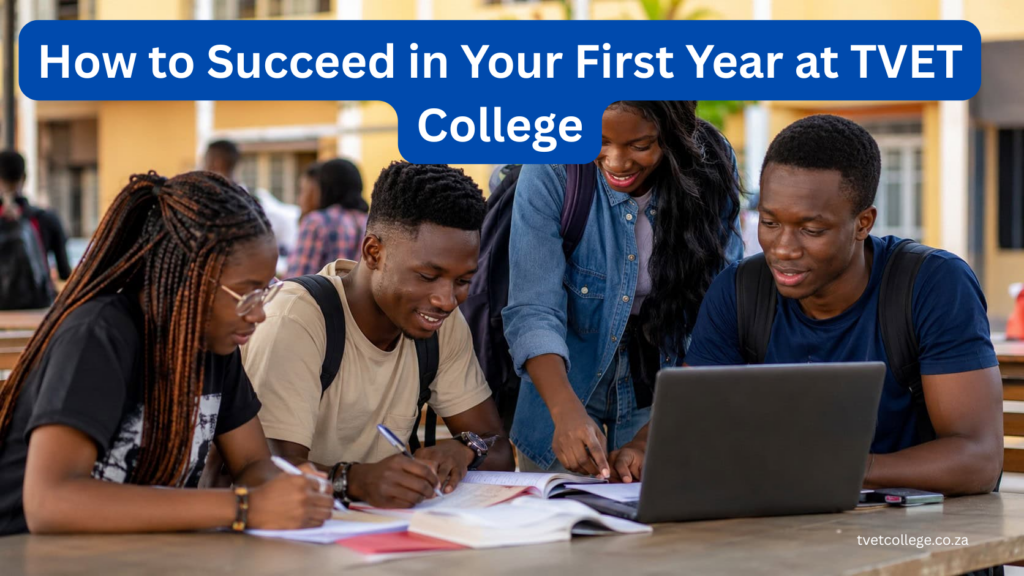
Read Also: How to Succeed in Your First Year at TVET College | Few Important Things You Should Know
Use computers and internet access productively.
Research from reliable sources.
Respect the study environment.
Most importantly, do not wait until examination season to discover what your library can offer.
The earlier you develop good research and independent study habits, the more useful those skills can become throughout your education and future career.
Your lecturers may introduce you to important knowledge, and practical workshops may help you develop hands-on skills. The library can support both by giving you a space and resources to explore subjects more deeply.
For many students, one of the smartest decisions they can make is simple: use the resources already available to them.
Share the article with others if you find it helpful.

Conversation
0 Comments