

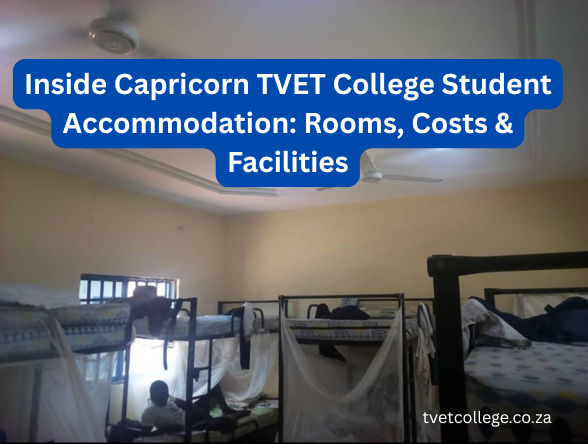
Before applying for Capricorn TVET College accommodation, here are a few things you should know. In this article, I will share with you my findings on the Inside Capricorn TVET College student accommodation rooms, costs & facilities.
Getting accepted to Capricorn TVET College can be an exciting step toward building your future, but admission is only one part of preparing for college. If you live far from your chosen campus, another important question quickly comes up: Where will you stay while studying?
Student accommodation can have a major impact on your college experience. A suitable place to live can make it easier to attend classes, complete assignments, rest properly, and manage your daily routine. On the other hand, choosing accommodation without checking the costs, location, facilities, and funding requirements can create unnecessary financial and academic pressure.
Students considering Capricorn TVET College often want answers to practical questions such as:
- Does Capricorn TVET College provide student accommodation?
- What do student rooms look like?
- How much does accommodation cost?
- Can NSFAS pay for accommodation?
- What facilities should students expect?
- Is private student accommodation available near the campuses?
- What should students check before paying for a room?
The most important thing to understand is that there is no single room type or fixed accommodation price that applies to every Capricorn TVET College student. Accommodation arrangements can differ according to the campus, property, room type, location, funding status, and academic year.
Capricorn TVET College operates across different locations in Limpopo, and students may use different accommodation arrangements depending on where they study. Some may live with family and commute, while others may use qualifying or accredited student accommodation near their campus.
This complete guide explains what prospective and current students should know about accommodation while studying at Capricorn TVET College, including rooms, facilities, costs, NSFAS considerations, private accommodation, transport, safety, and important questions to ask before signing a lease.
About Capricorn TVET College
Capricorn TVET College is a public Technical and Vocational Education and Training institution in Limpopo, South Africa.
The college offers vocational and career-focused education across several campuses, including:
- Polokwane Campus
- Seshego Campus
- Senwabarwana Campus
- Ramokgopa Campus
Because these campuses are located in different areas, accommodation conditions and private rental markets can vary considerably.
A student studying in Polokwane, for example, may have different accommodation options and costs from a student studying near another campus.
This is why students should research accommodation based on their specific campus rather than searching only for general information about Capricorn TVET College.
Does Capricorn TVET College Have Student Accommodation?
Students should confirm current accommodation arrangements directly through the college and relevant official funding channels before making financial commitments.
Accommodation availability should never be assumed simply because you have received an admission offer.
Students may need to consider options such as:
- Qualifying student accommodation
- Accredited private student accommodation
- Private rented rooms
- Shared houses or flats
- Living with family or relatives
- Daily commuting
Availability can change from one academic year to another.
The safest approach is to confirm the current process before registration or immediately after receiving your admission information.
Ask questions such as:
- What accommodation options are available for students at my campus?
- Is there an official accommodation application process?
- Which properties qualify under current NSFAS requirements?
- Are there deadlines for accommodation applications?
- Who should I contact if I need housing assistance?
Do not rely only on old social media posts or information from previous academic years.
Why Your Campus Matters When Choosing Accommodation
Capricorn TVET College has multiple campuses, so the best accommodation for one student may be completely unsuitable for another.
Before searching for a room, confirm exactly where your programme is offered.
Then consider:
- Distance from the campus
- Public transport availability
- Daily travel costs
- Safety of the route
- Access to shops and essential services
- Total monthly accommodation expenses
A room advertised as being “close to Capricorn TVET College” may not necessarily be close to your campus.
Always ask for the exact location and calculate the actual travel distance.
What Do Capricorn TVET College Student Rooms Look Like?
There is no single standard room design that applies to every student.
The room you receive or rent will depend on the accommodation provider and property.
A student room may be:
- A private single room
- A shared bedroom
- A room in a shared house
- A room in a student accommodation property
Depending on the property, a furnished room may include basic items such as:
- A bed
- A mattress
- A wardrobe or storage space
- A desk
- A chair
However, students should never assume that all of these items are automatically included.
Before moving in, request a written or clearly documented list of what the accommodation provides.
If possible, inspect the room before signing a lease or making a major payment.
Single Rooms Versus Shared Rooms
One of the first decisions students may need to make is whether to choose a private or shared room.
Single Rooms
A single room can provide greater privacy and may make it easier to control your study and sleeping environment.
Possible advantages include:
- More privacy
- Fewer distractions
- Greater personal space
- More control over noise
However, private rooms may cost more than shared accommodation.
Shared Rooms
Shared rooms may be more affordable because the cost of the accommodation is divided between occupants.
They can also make the transition to college life less lonely for some first-year students.
However, sharing requires patience and communication.
You and your roommate may have different:
- Study habits
- Sleeping schedules
- Cleaning standards
- Social preferences
Before moving in, it helps to discuss basic expectations about noise, visitors, cleaning, and shared belongings.
What Facilities Should Students Look For?
A room can look attractive in photographs while still lacking important facilities.
Students should look beyond decoration and consider how practical the accommodation will be for everyday college life.
Reliable Water Supply
Access to water is essential.
Ask:
- Is water included in the rent?
- Is the supply generally reliable?
- Are there backup arrangements where applicable?
Electricity
Find out exactly how electricity payments work.
Electricity may be:
- Included in the rent
- Prepaid
- Shared among tenants
- Subject to usage conditions
A room with cheaper rent may become more expensive if utilities are charged separately.
Internet Access
Reliable internet can be useful for:
- Research
- Assignments
- College communication
- Online learning resources
- Job and internship applications
If Wi-Fi is advertised, ask whether it is included in the rent and whether there are any limits or additional charges.
Study Space
A suitable study environment is extremely important.
Ideally, the room should provide a desk and chair, or the accommodation should have a quiet communal study area.
A student residence is not only somewhere to sleep. It should also support your academic routine.
Kitchen Facilities
If meals are not provided, you will need somewhere to prepare food.
Check whether the property has:
- A stove or other approved cooking facilities
- A refrigerator
- Food storage space
- A sink
- Adequate kitchen space
Also ask how many students share the kitchen.
Bathroom Facilities
Bathrooms may be private or shared.
Before moving in, ask:
- How many students share the bathroom?
- Is hot water available?
- Who is responsible for cleaning shared areas?
Laundry Facilities
Find out whether:
- Washing machines are available
- Laundry use costs extra
- There is a safe place to dry clothes
These details may seem small before moving in but can significantly affect everyday life.
How Much Does Capricorn TVET College Student Accommodation Cost?
There is no single accommodation fee that can accurately represent every Capricorn TVET College student.
Costs may vary according to:
- Campus location
- Type of property
- Single or shared room
- Distance from campus
- Furnished or unfurnished accommodation
- Included utilities
- Internet access
- Security and other facilities
For this reason, students should be cautious of websites that publish one fixed accommodation price without explaining the property, year, funding category, or source of the information.
The most reliable approach is to compare current accommodation options available for your specific campus and confirm applicable funding arrangements before signing a lease.
Understanding the Real Cost of Accommodation
Monthly rent is only one part of the cost of living away from home.
Students may also need to budget for:
- Deposit
- Electricity
- Water
- Wi-Fi or mobile data
- Transport
- Food
- Laundry
- Cleaning supplies
- Bedding
- Personal expenses
For example, a cheaper room far from campus may require daily transport. Once transport is added, it could cost more overall than a slightly more expensive room located closer to your classes.
When comparing accommodation, calculate:
Rent + utilities + transport + other compulsory monthly expenses
This gives you a more realistic picture of affordability.
NSFAS and Capricorn TVET College Accommodation
Eligible students at public TVET colleges may qualify for accommodation or transport support under applicable NSFAS rules.
However, students should understand that NSFAS accommodation funding is subject to eligibility requirements, current funding rules, accommodation processes, and applicable limits.
Students should not assume that any room advertised near Capricorn TVET College will automatically qualify for NSFAS-funded accommodation.
Under NSFAS accommodation processes, accreditation and approval requirements can apply to student properties. Students who intend to rely on NSFAS should therefore verify the status of the accommodation and follow the current official process before committing to a property.
Students should also understand that accommodation and transport support are generally treated differently. Your living arrangement and other eligibility requirements can affect which support applies to you.
Because funding policies and allowance amounts can change, always check the rules for the current academic year rather than relying on figures from an old article or social media post.
Accredited Accommodation: Why It Matters
For an NSFAS-funded student, choosing accommodation without checking its status can create serious financial problems.
A landlord may say that a property is “student accommodation,” but that does not automatically mean it meets the requirements for NSFAS accommodation payments.
Before moving in, verify the current process.
Ask:
- Is this property recognised under the applicable student accommodation process?
- Can its status be verified through an official channel?
- Is there a formal lease agreement?
- Who receives the accommodation payment?
- Are there additional costs not covered by funding?
Do not rely entirely on a landlord’s verbal promise.
How to Search for Accommodation Near Your Campus
Begin by confirming your campus and registration status.
Then use official college and NSFAS guidance where applicable to understand the accommodation process.
When considering a property, check:
- Exact address
- Distance from campus
- Transport route
- Monthly cost
- Deposit
- Facilities
- Security
- Lease conditions
Where practical, inspect the room personally or ask a trusted adult to help verify the property before making a major payment.
Location and Transport
A room does not need to be directly next to the campus to be suitable, but the journey should be practical and affordable.
Ask yourself:
- Can I get to morning classes on time?
- How long will the journey take?
- How much will I spend on transport each month?
- Is transport available after afternoon classes?
- Is the route practical throughout the academic year?
Long daily journeys can reduce the time available for studying and rest.
Sometimes paying slightly more for a conveniently located room may reduce your overall monthly expenses.
Safety and Security
Safety should be an important part of any accommodation decision.
Students should check for reasonable security features such as:
- Working door locks
- Secure windows
- Controlled entry where available
- Adequate lighting
- Safe access to the property
Also consider the route between the accommodation and campus or public transport.
Avoid choosing a property based only on attractive photographs.
Where possible, visit the area and evaluate the practical environment before committing.
Questions to Ask Before Paying a Deposit
Before paying for accommodation, ask:
- What is the total monthly rent?
- What exactly is included?
- Is electricity included?
- Is water included?
- Is Wi-Fi included?
- Is a deposit required?
- What are the refund conditions?
- Is the room furnished?
- Is the room private or shared?
- How many students share the bathroom?
- Are cooking facilities available?
- What are the residence rules?
- Who handles repairs?
- Is there a written lease agreement?
- How far is the property from my campus?
Never feel pressured to pay before understanding what you are paying for.
Avoiding Accommodation Scams
Students searching urgently for rooms can become targets for misleading listings and accommodation scams.
Warning signs may include:
- Pressure to pay immediately
- Refusal to provide clear property information
- Prices that appear unusually low without explanation
- No written agreement
- Requests for payment before reasonable verification
- Conflicting information about the property
Be careful with accommodation advertised through unofficial social media accounts or private messages.
A professional-looking photograph does not prove that the person advertising the room owns or manages the property.
Where possible, verify the property and payment details before transferring money.
What to Inspect Before Moving Into Student Accommodation
Finding an available room can be exciting, especially when the academic year is approaching and accommodation options are becoming limited. However, students should avoid rushing into the first property they find.
Before moving in, inspect the accommodation carefully where possible.
Start with the bedroom.
Check:
- Whether the door locks properly
- The condition of the windows
- Available storage space
- Whether the room has adequate lighting
- The condition of any furniture provided
- The number of students expected to share the room
If the room is advertised as furnished, confirm exactly what that means.
A furnished room may include a bed and wardrobe but not necessarily bedding, a study desk, refrigerator, or other personal items.
Taking photographs of the room’s condition before moving in may also be useful when renting privately, particularly where a refundable deposit is involved.
Check the Bathroom and Kitchen
A comfortable bedroom is important, but shared facilities can have an even greater impact on your daily experience.
Inspect the bathroom.
Ask:
- How many students share it?
- Is hot water available?
- Who is responsible for cleaning?
- Are the locks and plumbing working properly?
The same applies to the kitchen.
If you plan to prepare your own meals, check whether appropriate cooking and food-storage facilities are available.
A property shared by many students but equipped with very limited cooking facilities may become inconvenient during busy periods.
Check Electricity, Water and Internet Arrangements
Do not assume that utilities are automatically included in the advertised rental price.
Ask the accommodation provider to explain clearly how each service works.
For electricity, find out whether it is:
- Included in the rent
- Prepaid
- Shared between tenants
- Subject to specific conditions
For internet access, ask whether Wi-Fi is included and whether there are any additional charges or usage restrictions.
These expenses can significantly change the real monthly cost of accommodation.
A Complete Capricorn TVET College Student Accommodation Checklist
Before choosing accommodation near your Capricorn TVET College campus, use this checklist.
Location
- Confirm your exact campus.
- Check the distance between the property and campus.
- Calculate daily transport costs.
- Consider travel time.
- Check access to essential services.
Room
- Confirm whether it is private or shared.
- Check the condition of the bed and furniture.
- Confirm available storage.
- Check whether there is a study desk.
- Test the door and window locks where appropriate.
Facilities
- Check water availability.
- Understand electricity arrangements.
- Confirm internet availability.
- Inspect the bathroom.
- Inspect cooking facilities.
- Ask about laundry arrangements.
Costs
- Confirm the full monthly amount.
- Ask about deposits.
- Ask whether utilities are included.
- Calculate transport costs.
- Ask about any additional compulsory charges.
Documentation
- Read the rental or accommodation agreement.
- Keep proof of payments.
- Understand cancellation terms.
- Verify applicable accommodation requirements if relying on NSFAS funding.
A few extra questions before moving in can prevent major problems later.
What Should Students Pack?
What you need to bring depends on what the accommodation already provides.
Do not buy everything before confirming what is included.
Bedroom Essentials
You may need:
- Bedding
- Pillows
- Blankets
- Towels
- Clothes hangers
- Storage containers
Study Essentials
Consider bringing:
- Notebooks
- Pens
- Study lamp where appropriate
- Extension lead if permitted
- Laptop or other study device if available
Kitchen Essentials
Depending on the property rules and shared facilities, you may need:
- Plate
- Cup
- Cutlery
- Food containers
- Basic cooking utensils
Avoid buying unnecessary appliances before checking what is already available and what the residence permits.
Personal Essentials
Remember items such as:
- Toiletries
- Laundry supplies
- Cleaning products
- Personal medication where applicable
Create a checklist before moving so that you do not forget important items.
Living With a Roommate
Sharing a room can help reduce accommodation costs, but successful shared living requires communication.
You and your roommate may have completely different habits.
One person may prefer studying late at night while the other sleeps early. One may enjoy having friends visit, while the other values privacy.
Discuss expectations early.
Important topics include:
- Cleaning
- Noise
- Visitors
- Study time
- Shared items
- Personal boundaries
Do not assume your roommate automatically understands your preferences.
Respectful communication can prevent small disagreements from becoming major conflicts.
Protect Your Personal Belongings
Even in student accommodation, students should take reasonable care of their belongings.
Avoid leaving valuable items unattended in shared areas.
Keep important documents secure, including:
- Identification documents
- Bank information
- Academic records
- Funding documents
Do not share passwords, PINs, or sensitive financial information with roommates or acquaintances.
Understanding Residence Rules
Student accommodation may have rules designed to protect residents and manage shared living spaces.
These may cover:
- Visitors
- Noise
- Alcohol or prohibited substances
- Smoking
- Overnight guests
- Property damage
- Access times
- Cleaning
- Safety procedures
Read the rules before moving in.
Do not assume that because you are paying rent, you can ignore the terms of your accommodation agreement.
Breaking serious rules may have consequences under the applicable agreement.
Budgeting for Student Accommodation
A good student budget should consider more than monthly rent.
Your monthly expenses may include:
- Accommodation
- Transport
- Food
- Electricity
- Data
- Laundry
- Toiletries
- Academic expenses
Start with essential costs.
If you receive financial support, avoid spending large amounts on non-essential purchases at the beginning of the month and then struggling with transport or food later.
A simple monthly budget can help you understand where your money is going.
Saving Money While Living Away From Home
Student life can become expensive, but small decisions can reduce unnecessary spending.
Prepare Your Own Meals
Buying takeaway food regularly can become costly.
Where safe and permitted, preparing meals may help reduce expenses.
Share Appropriate Household Costs
Students living together may share the cost of certain household supplies, provided everyone agrees.
Plan Transport Carefully
Calculate whether walking, public transport, or another available option is most practical and safe.
Avoid Unnecessary Purchases
You do not need to buy every room decoration or appliance immediately.
Start with essentials and add other items gradually.
Balancing Accommodation and Academic Life
The best student accommodation should support your education rather than constantly distract you from it.
Living away from home can provide greater independence, but that independence comes with responsibility.
You may need to manage:
- Cooking
- Cleaning
- Laundry
- Shopping
- Studying
- Attending classes
Creating a weekly routine can help.
For example, choose specific times for:
- Studying
- Cleaning
- Laundry
- Grocery shopping
Good organisation prevents everyday responsibilities from becoming overwhelming.
Common Accommodation Mistakes Students Should Avoid
Choosing a Room Without Confirming the Campus
Capricorn TVET College has multiple campuses.
Always confirm where your programme is offered before renting a room.
Paying Before Proper Verification
Urgency can lead students to make risky payments.
Take reasonable steps to verify the property, agreement, and payment details.
Looking Only at the Monthly Rent
A cheaper room may have expensive transport and utility costs.
Calculate the total cost.
Assuming NSFAS Will Cover Any Property
Students relying on funding should verify current accommodation rules and applicable requirements before committing.
Ignoring the Rental Agreement
Read the agreement before signing.
Pay attention to:
- Payment terms
- Deposit conditions
- Cancellation rules
- Residence policies
Choosing Friends Without Considering Compatibility
A good friend is not always a compatible roommate.
Discuss expectations before living together.
What If You Cannot Find Accommodation Near Campus?
If accommodation close to your campus is unavailable, consider widening your search to areas with practical transport connections.
However, calculate the cost and time of commuting before making a decision.
You can also seek current guidance through appropriate official college channels regarding available accommodation processes or student support.
Avoid making rushed decisions based on unverified advertisements.
Frequently Asked Questions
Does Capricorn TVET College provide student accommodation?
Accommodation arrangements and availability may differ by campus and academic year. Students should confirm the current options and procedures directly through official Capricorn TVET College channels.
How much does Capricorn TVET College student accommodation cost?
There is no single price that applies to every student. Costs depend on the location, room type, facilities, utilities, and accommodation provider.
Can NSFAS pay for accommodation?
Eligible students may receive accommodation support subject to current NSFAS funding rules, applicable limits, and accommodation requirements. Students should verify the current process before signing a lease.
Are all private rooms near Capricorn TVET College approved for funded students?
No. A room being advertised as student accommodation does not automatically mean it meets applicable NSFAS requirements.
Is it better to stay near campus?
Living close to campus can reduce transport costs and travel time, but students should compare rent, facilities, safety, and total monthly expenses.
Should I choose a single or shared room?
The best choice depends on your budget and personal preferences. Single rooms offer more privacy, while shared rooms may be more affordable.
What facilities should student accommodation have?
Important facilities may include reliable water, electricity, appropriate bathroom and kitchen access, reasonable security, and a suitable place to study. Internet and laundry facilities may also be valuable.
Should I pay a deposit before viewing a room?
Students should be cautious about making major payments before reasonably verifying a property and understanding the agreement. Where practical, inspect the accommodation and keep proof of all payments.
Final Thoughts
Finding suitable accommodation while studying at Capricorn TVET College requires more than simply choosing the cheapest available room.
Your accommodation can affect:
- Your finances
- Your daily travel
- Your study routine
- Your comfort
- Your overall college experience
Start by confirming the campus where your programme is offered.
Then compare accommodation based on the total cost, not only the advertised rent.
Check the room.
Inspect the facilities.
Understand the payment terms.
Ask about utilities.
Consider transport.
Read Also: Inside the TVET College Library: Everything Students Should Know
Verify current funding requirements if you rely on NSFAS.
Most importantly, avoid making rushed payments because someone claims that a room is about to disappear.
A good student room does not need to be luxurious. It needs to be practical, affordable, reasonably secure, and suitable for your academic routine.
Whether you live in a private room, shared house, student residence, or with relatives, the goal is the same: to create a living arrangement that allows you to focus on completing your studies.
Planning early can give you more options and reduce unnecessary stress when the academic year begins.
Share the article with others if you find it helpful.



Conversation
0 Comments