

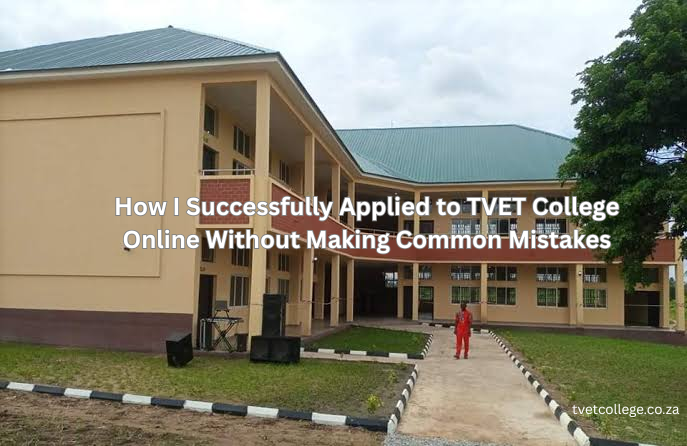
I am Excel Eze. In this article, I will share with you my personal experience on How I Successfully Applied to TVET College Online Without Making Common Mistakes. So read this carefully so you can get real value from this article.
Applying to a Technical and Vocational Education and Training (TVET) college online may seem like a simple process, but many students make avoidable mistakes that delay or even prevent their admission. When I decided to apply to a TVET college, I quickly realized that the application process involved much more than simply filling out an online form.
From gathering the correct documents to selecting the right course and ensuring every detail was accurate, every step mattered. I also discovered that many applicants lose their admission opportunities because they upload the wrong documents, choose incorrect study programmes, miss important deadlines, or fail to follow the college’s instructions.
Fortunately, I took the time to research the process, prepare everything in advance, and carefully complete my application. As a result, I submitted my application successfully without encountering the common problems that many applicants experience.
In this guide, I will share my entire experience—from preparing for the application to submitting it successfully. Whether you are applying to your first TVET college or trying again after an unsuccessful application, this article will help you avoid common mistakes and improve your chances of a successful application.
If you follow these steps carefully, you’ll save yourself time, reduce unnecessary stress, and increase your chances of being accepted into your preferred TVET college.
Why I Chose a TVET College
Before beginning my application, I spent time researching different education options available after high school.
Although universities remain a popular choice, I discovered that TVET colleges offer several unique advantages.
Some of the reasons I chose a TVET college included:
- Practical, hands-on learning
- Lower tuition costs compared to many universities
- Industry-relevant skills
- Nationally recognized qualifications
- Opportunities for apprenticeships and workplace training
- Better preparation for employment or entrepreneurship
Many employers today are looking for graduates with practical skills rather than only theoretical knowledge. TVET colleges focus on preparing students for real jobs by combining classroom learning with practical training.
That convinced me that applying to a TVET college was the right decision.
The Biggest Mistake I Almost Made
One mistake nearly cost me my application.
Initially, I assumed that I could complete the application within an hour.
I couldn’t have been more wrong.
After visiting several TVET college websites, I realized I needed numerous documents, certified copies, personal information, academic records, and accurate contact details.
Had I waited until the application deadline, I probably would have missed it.
Instead, I decided to prepare everything before opening the application portal.
Looking back, this was probably the smartest decision I made.
Step 1: I Researched Different TVET Colleges
Rather than applying immediately, I first compared several colleges.
Every TVET college offers different programmes.
Some specialize in engineering.
Others focus on business studies.
Some have excellent hospitality departments.
Others are known for information technology or agriculture.
Instead of choosing the nearest college, I asked myself several important questions:
- Which programme matches my career goals?
- Does the college offer workplace training?
- What qualifications are required?
- Is financial aid available?
- What are previous students saying about the college?
Doing this research helped me avoid applying for a programme that wasn’t suitable for my future career.
Step 2: I Carefully Checked the Admission Requirements
This is one area where many applicants make mistakes.
Many students assume that because they passed Grade 12, they automatically qualify for every programme.
That isn’t always true.
Different programmes have different admission requirements.
Some courses require higher Mathematics marks.
Others accept Mathematical Literacy.
Engineering courses may require Physical Science.
Business courses may focus more on language and accounting subjects.
Before applying, I carefully read every admission requirement for my preferred programme.
This saved me from applying for courses where I wasn’t eligible.
Step 3: I Prepared Every Required Document Before Starting
One lesson I quickly learned was that preparing documents beforehand makes the application process much easier.
I created a folder on my computer containing every required document.
This included:
My Identification Document
I scanned both sides clearly.
The copy was readable and saved as a PDF.
My Academic Results
I included:
- Grade 11 results (where required)
- Grade 12 June results
- Final matric certificate (if available)
I ensured every page was clear and complete.
Proof of Residence
Many colleges request proof of where applicants live.
I prepared mine in advance.
Certified Copies
Where certification was required, I made sure they were recently certified and clearly visible.
Supporting Documents
Depending on your circumstances, you may also need:
- Passport (international students)
- Study permit
- Parent or guardian identification
- Disability supporting documents
- Financial aid documents
Having everything ready before starting saved me a lot of stress.
Step 4: I Used a Reliable Internet Connection
This may sound obvious, but many online applications fail because of unstable internet.
Imagine uploading six documents only for the connection to disconnect before submission.
To avoid this, I:
- Used reliable Wi-Fi
- Charged my laptop fully
- Closed unnecessary browser tabs
- Avoided using public internet connections
This reduced the chances of losing my application halfway through.
Step 5: I Created My Online Account Carefully
Most TVET colleges require applicants to create an online profile before submitting an application.
This profile usually includes:
- Full names
- Email address
- Mobile number
- Password
- Security questions
I made sure:
- My email address was active.
- My phone number was correct.
- My password was secure.
- I saved my login details safely.
Many applicants forget their passwords shortly after registering.
I wrote mine down in a secure location.
Step 6: I Double-Checked Every Personal Detail
One of the most common mistakes applicants make is entering incorrect personal information.
Before moving to the next page, I checked every detail carefully.
I confirmed:
- Full names
- Date of birth
- Identity number
- Gender
- Nationality
- Residential address
- Postal address
- Phone number
- Email address
Even a small typing error could create problems later during registration.
I preferred spending five extra minutes checking everything rather than dealing with corrections afterward.
Step 7: I Chose My Study Programme Carefully
This was another important step.
Some students rush through programme selection without fully understanding what they are choosing.
Instead of selecting a course simply because my friends were applying for it, I asked myself:
- Do I enjoy this field?
- Are there employment opportunities?
- Does this qualification match my long-term career goals?
- Can I see myself working in this industry for years?
After answering these questions honestly, I felt much more confident about my choice.
Choosing the right programme is one of the most important decisions you’ll make because it shapes your future career.
Step 8: I Uploaded Clear, Correctly Formatted Documents
One mistake that often leads to delays is uploading documents that are blurry, incomplete, upside down, or in the wrong format.
Before uploading each file, I checked that:
- The scan was clear and easy to read.
- The document was complete.
- The correct file was selected.
- The file size met the college’s requirements.
- The document was saved in the required format, such as PDF or JPEG.
Taking a few extra moments to review each upload gave me confidence that my application would not be rejected due to poor document quality.
A Lesson I Learned Early
The most valuable lesson I learned during my application journey was this:
Preparation is far more important than speed.
Many students rush to submit their applications as quickly as possible, believing that submitting first guarantees acceptance. In reality, submitting an accurate, complete, and well-prepared application is much more important than simply being fast.
Because I gathered my documents, researched my course, checked the admission requirements, and reviewed every detail before clicking “Submit,” the entire process became much less stressful.
That preparation saved me from making mistakes that could have delayed my admission or required me to start the application all over again.
How I Successfully Applied to TVET College Online Without Making Common Mistakes (Part 2)
Step 9: I Reviewed Every Section Before Clicking “Submit”
After completing the application form and uploading all the required documents, I resisted the urge to click the “Submit” button immediately.
Instead, I carefully reviewed every section of my application.
This turned out to be one of the best decisions I made.
I checked:
- My full name and surname
- Identity or passport number
- Date of birth
- Email address
- Phone number
- Residential address
- Selected TVET college campus
- Chosen programme
- Uploaded documents
- Subject marks
- Any additional information requested
Even a single typo can create unnecessary delays. For example, an incorrect phone number could prevent the college from contacting you if they need more information. Likewise, selecting the wrong programme by mistake could affect your admission.
Taking an extra 10–15 minutes to review everything gave me confidence that my application was complete and accurate.
Step 10: I Submitted My Application Before the Deadline
One mistake many applicants make is waiting until the last day to apply.
I avoided this completely.
Online application systems often experience heavy traffic close to the deadline. This can lead to:
- Slow-loading pages
- Website crashes
- Failed document uploads
- Incomplete submissions
- Server errors
Rather than taking that risk, I submitted my application several weeks before the closing date.
Submitting early gave me enough time to fix any issues if the college requested additional documents or corrections.
It also reduced my stress because I wasn’t racing against the clock.
Step 11: I Saved My Application Reference Number
Immediately after submitting my application, the system generated a confirmation message along with a reference or application number.
Many applicants overlook this important detail.
I copied the reference number and stored it in multiple places:
- My notebook
- My phone
- My email
- A document on my computer
This number became essential whenever I wanted to:
- Track my application status
- Contact the admissions office
- Update my information
- Resolve any issues
Without it, finding your application can be much more difficult.
Step 12: I Downloaded and Printed the Confirmation
After submitting my application, I downloaded the confirmation page and saved it as a PDF.
I also printed a hard copy.
This served as proof that my application had been submitted successfully.
If any technical issue arose later, I had evidence showing:
- The submission date
- My reference number
- The programme I applied for
- My personal details
Keeping copies of important documents is a simple habit that can save a lot of trouble later.
Step 13: I Regularly Checked My Email
Submitting the application wasn’t the end of the process.
In fact, it was just the beginning.
After applying, I checked my email almost every day.
TVET colleges often send important updates such as:
- Application received confirmation
- Missing document requests
- Additional information requests
- Interview invitations (where applicable)
- Placement assessments
- Admission offers
- Registration instructions
Missing an email could mean missing an important deadline.
To avoid this, I also checked my spam and junk folders regularly because automated emails sometimes end up there.
Step 14: I Tracked My Application Online
Most TVET colleges provide an online portal where applicants can monitor the progress of their applications.
I logged into my account every few days to check whether the status had changed.
Common application statuses include:
- Submitted
- Received
- Under Review
- Documents Verified
- Awaiting Decision
- Provisionally Accepted
- Accepted
- Unsuccessful
Checking the portal regularly helped me stay informed instead of worrying unnecessarily.
Common Mistakes I Successfully Avoided
During my application journey, I noticed several mistakes that many students make.
Thankfully, I managed to avoid them.
Here are some of the most common ones.
1. Applying Without Reading the Requirements
Some applicants jump straight into the application process without checking whether they qualify for the programme.
I made sure to read every admission requirement before applying.
2. Uploading Blurry Documents
Poor-quality document scans are one of the most common reasons applications are delayed.
I scanned every document in high quality and checked each file before uploading.
3. Using an Inactive Email Address
Your email is the primary way colleges communicate with applicants.
I used an email account that I checked daily.
4. Providing the Wrong Phone Number
A simple typing error can prevent the admissions office from contacting you.
I verified my phone number multiple times before submitting.
5. Waiting Until the Last Minute
Perhaps the biggest mistake is leaving the application until the final day.
Early applications reduce stress and provide time to correct mistakes if necessary.
6. Ignoring Application Instructions
Every TVET college may have slightly different procedures.
Instead of assuming every application was the same, I carefully followed the instructions provided by the college.
7. Forgetting to Save Login Details
After creating my account, I stored my username and password securely.
This made it easy to log back in whenever I needed to check my application status.
8. Choosing a Course Without Research
I didn’t select a programme simply because it sounded interesting.
Instead, I considered:
- Career opportunities
- Industry demand
- My interests
- Future earning potential
- Available workplace training
This helped me choose a course that aligned with my long-term goals.
What Happened After I Applied?
After submitting my application, I experienced a waiting period.
At first, I felt anxious.
Like many applicants, I kept wondering:
- Did I upload everything correctly?
- Will I be accepted?
- Did I choose the right programme?
- When will I receive feedback?
Instead of worrying constantly, I focused on staying prepared.
I kept all my documents organized and monitored both my email and the application portal regularly.
Eventually, I received communication confirming that my application had been received and was being processed.
Knowing that I had followed every step correctly gave me peace of mind throughout the waiting period.
Tips That Made My Application Easier
Looking back, there are several habits that made the entire process much smoother:
- I started preparing early.
- I researched different TVET colleges before deciding where to apply.
- I kept digital copies of every important document.
- I used a reliable internet connection.
- I reviewed every page before submission.
- I submitted well before the deadline.
- I saved my reference number immediately.
- I checked my email and application portal regularly.
- I remained patient while waiting for updates.
These simple habits can make a significant difference for any applicant.
My Advice to Future TVET College Applicants
If you’re planning to apply to a TVET college online, don’t rush the process.
Treat your application like an important project.
Take time to:
- Understand the admission requirements.
- Prepare all documents in advance.
- Read every instruction carefully.
- Double-check your information.
- Submit your application early.
- Stay organized throughout the process.
Remember, a successful application isn’t about luck—it’s about careful preparation and attention to detail.
By avoiding common mistakes and following each step carefully, you can greatly improve your chances of having a smooth and successful application experience.
Share the article with others if you find it helpful.
Conversation
0 Comments