Public Technical and Vocational Education and Training colleges represent South Africa’s most accessible pathway to quality vocational training, professional certification, and career-ready skills development. As government-funded institutions, these colleges offer affordable education with comprehensive financial aid options, making technical education accessible to students from all economic backgrounds.
For students who missed standard application deadlines, public TVET colleges maintain flexible late application procedures, ensuring that motivated individuals can still access quality programs in engineering, business management, information technology, hospitality management, healthcare training, and numerous other fields that drive South Africa’s economy.
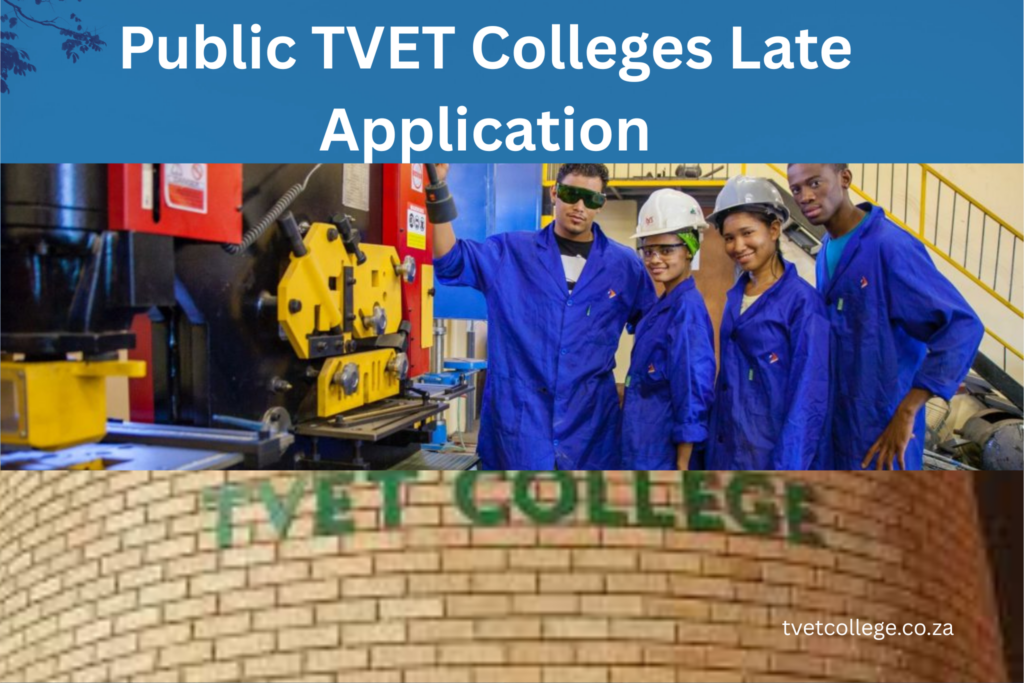
This comprehensive guide explains how public TVET colleges differ from private institutions, outlines late application procedures, explores government funding opportunities, and provides strategic advice for securing enrollment in your preferred vocational training program.
Public vs Private TVET Colleges: Understanding Your Options
Government-Funded Public Colleges
Public TVET colleges operate under the Department of Higher Education and Training, receiving government subsidies that enable affordable tuition and comprehensive student support services. These institutions prioritize accessibility, maintaining open admission policies, offering extensive financial aid programs, and serving communities across all provinces.
Key Advantages of Public Colleges:
Affordable Tuition: Government subsidies significantly reduce costs compared to private institutions. Annual fees typically range from R5,000 to R15,000 for most programs, with NSFAS covering full costs for eligible students.
NSFAS Accessibility: Only public TVET colleges qualify for National Student Financial Aid Scheme funding, providing comprehensive support including tuition coverage, accommodation allowances, meal stipends, transport support, and learning material funding.
Quality Assurance: Public colleges maintain accreditation from the Council for Higher Education and quality monitoring from government departments, ensuring consistent educational standards and recognized qualifications.
Community Focus: Public institutions serve broader communities, maintaining multiple campuses in urban and rural areas, offering programs aligned with regional economic needs, and supporting local skills development initiatives.
Infrastructure Investment: Government capital expenditure provides modern facilities, updated equipment, computer laboratories, workshops, libraries, and student support centers.
Private TVET Institutions
Private colleges operate independently, charging higher tuition fees but often offering specialized programs, flexible scheduling, smaller class sizes, and niche career focus areas. However, these institutions don’t qualify for NSFAS funding, making them less accessible for students requiring financial assistance.
Why Choose Public TVET Colleges
Financial Accessibility Through Government Support
Public TVET colleges remove financial barriers to education through multiple government-funded programs:
NSFAS Comprehensive Funding: Eligible students receive full financial coverage eliminating out-of-pocket education costs. This includes complete tuition payment, on-campus or off-campus accommodation support, daily meal allowances, textbook and learning material funding, and monthly transport stipends.
Fee-Free Education Initiatives: Government programs targeting students from low-income households provide completely free vocational training, removing all financial obstacles to skills acquisition and professional development.
Subsidized Programs: Even students who don’t qualify for complete NSFAS coverage benefit from government subsidies that reduce tuition to affordable levels, typically 50-70% below private institution costs.
Flexible Payment Options: Public colleges offer payment plans, installment arrangements, and deferred payment options for self-funded students, making education manageable for working adults and families.
Quality Vocational Training Programs
Public TVET colleges maintain high educational standards through:
Qualified Instructors: Government employment standards ensure instructors possess appropriate qualifications, industry experience, and teaching certifications.
Standardized Curriculum: National curriculum frameworks guarantee consistent quality across institutions, ensuring all graduates meet industry requirements and professional standards.
Modern Equipment: Government capital investment provides current technology, industry-standard equipment, and updated facilities matching workplace environments.
Workplace Integration: Mandatory workplace experience components ensure graduates possess practical skills and employer connections facilitating smooth workforce entry.
Recognized Qualifications and Career Advancement
Qualifications from public TVET colleges carry significant weight:
Industry Recognition: Employers across sectors recognize and value public TVET qualifications, viewing graduates as properly trained and work-ready.
Professional Certification: Programs align with professional body requirements, enabling graduates to pursue industry certifications and licenses.
Articulation Pathways: Universities accept TVET qualifications for degree program admission, allowing graduates to pursue advanced education.
Government Employment: Public sector positions often specify TVET qualifications in job requirements, creating direct employment pathways.
Public TVET Colleges Accepting Late Applications
Comprehensive National Network
South Africa’s public TVET system comprises 50 institutions with over 260 campuses serving every province:
Gauteng Public Colleges
Ekurhuleni East TVET College operates campuses in Kempton Park, Springs, and Tembisa, offering engineering programs, business studies, information technology, and hospitality management. Late applications accepted through January and February with extended intake for programs with availability.
Ekurhuleni West TVET College serves Germiston, Katlehong, and Daveyton with strong engineering programs, business courses, and technical training. Walk-in applications welcomed with same-day processing for available programs.
Central Johannesburg TVET College maintains campuses across Johannesburg Central, Roodepoort, and Soweto, specializing in business administration, tourism operations, engineering studies, and multimedia programs. Online and in-person late applications accepted.
Tshwane South TVET College covers Atteridgeville, Centurion, and Pretoria areas with comprehensive engineering programs, primary healthcare training, business management, and information technology courses. Organized walk-in sessions throughout late application period.
Tshwane North TVET College serves northern Pretoria areas including Temba, Soshanguve, and Rosslyn, focusing on automotive technology, welding, construction studies, and engineering programs. Late applications processed at all campuses.
South West Gauteng TVET College operates in Randfontein, Roodepoort, and Kagiso, offering business studies, engineering programs, and hospitality training. Multiple intake opportunities throughout early months.
Sedibeng TVET College serves Vereeniging, Vanderbijlpark, and Sebokeng with engineering, business, and hospitality programs. Rural outreach facilitates access for surrounding communities.
Western Cape Public Colleges
College of Cape Town represents the province’s flagship institution with five campuses offering multimedia design, culinary arts, engineering programs, business management, and information technology. Sophisticated online application system with walk-in support.
False Bay TVET College maintains four campuses across Westlake, Muizenberg, Khayelitsha, and Fish Hoek, specializing in tourism, engineering, and business studies. Late application procedures accommodate diverse community needs.
Northlink TVET College operates across Bellville, Parow, and Wingfield with outstanding fashion design, hospitality management, IT programs, and engineering courses. Streamlined late application processing.
South Cape TVET College serves George, Mossel Bay, and Oudtshoorn with agriculture, engineering, and business programs tailored to regional economic needs.
KwaZulu-Natal Public Colleges
Coastal TVET College covers Durban, Umlazi, KwaMashu, and Asherville with strong engineering, business management, office administration, and marketing programs. Late applications welcomed across all campuses.
Majuba TVET College operates in Newcastle, Dundee, and Madadeni, offering civil engineering, mechanical engineering, business studies, and hospitality programs with strong community connections.
Umfolozi TVET College serves Richards Bay, Empangeni, and eSikhaleni, specializing in electrical installation, mechanical engineering, finance, and business programs aligned with regional industry.
Thekwini TVET College maintains multiple Durban-area campuses with comprehensive IT programs, business management courses, and engineering studies.
Elangeni TVET College covers Pinetown, Ndwedwe, and surrounding areas with diverse programming supporting local skills development.
Eastern Cape Public Colleges
Buffalo City TVET College operates four campuses across East London, King William’s Town, Mdantsane, and Queenstown with strong engineering, hospitality, and business programs.
Ikhala TVET College serves rural Eastern Cape communities through campuses in Queenstown, Whittlesea, and Sterkspruit, focusing on agriculture, construction, and business training.
King Hintsa TVET College maintains campuses in Alice, Butterworth, and Komani with engineering, business, and hospitality programs.
Lovedale TVET College covers Alice, King William’s Town, Queenstown, and Zwelitsha with comprehensive technical and business programming.
Ingwe TVET College serves Mthatha and surrounding areas with diverse vocational training aligned with community needs.
Port Elizabeth TVET College operates across multiple Port Elizabeth locations with engineering, business, and technical programs.
Additional Provincial Public Colleges
Limpopo Province: Capricorn, Lephalale, Mopani South East, Sekhukhune, and Vhembe TVET colleges serve the province with engineering, agriculture, business, and technical programs.
Mpumalanga Province: Ehlanzeni, Gert Sibande, and Nkangala TVET colleges offer tourism, engineering, mining-related courses, and business programs.
North West Province: Orbit and Taletso TVET colleges provide engineering, hospitality, business, and agriculture programs.
Northern Cape Province: Northern Cape Urban and Northern Cape Rural colleges serve communities with engineering, agriculture, hospitality, and business training.
Free State Province: Flavius Mareka, Goldfields, and Maluti TVET colleges offer engineering, mining studies, business management, and tourism programs.
Late Application Process for Public TVET Colleges
Step-by-Step Enrollment Guide
Step 1: Identify Available Colleges and Programs
Research public TVET colleges in your preferred location. Review program offerings and availability during late application period. Consider alternative locations if first-choice programs are full. Verify campus accessibility via public transport or accommodation options.
Step 2: Verify Late Application Dates
Contact college admissions offices to confirm current late application dates. Check official college websites for announcements. Follow college social media for real-time updates. Note that dates vary by institution and program.
Step 3: Gather Required Documentation
Prepare certified copies of South African ID document or birth certificate, National Senior Certificate or equivalent qualification, complete academic transcript with all grades, recent proof of residence (utility bill or affidavit), and passport-sized photographs. For NSFAS applicants, prepare household income documentation.
Step 4: Complete Application Procedures
Online Applications: Visit college website application portal, create user account with valid email, complete application form with accurate information, upload required documents in specified formats, submit application and save confirmation reference.
Walk-In Applications: Arrive early at designated campus locations, collect application forms from admissions office, complete forms accurately and legibly, submit with all required documents, receive stamped acknowledgment or reference number.
Step 5: Apply for NSFAS Funding
Visit www.nsfas.org.za to access application portal. Complete NSFAS application providing accurate financial information. Upload required supporting documents including ID copies, proof of income, and consent forms. Link NSFAS application to your TVET college application. Monitor application status regularly through NSFAS portal.
Step 6: Attend Placement Testing (If Required)
Some programs require placement tests assessing mathematics, language, and subject-specific knowledge. Prepare by reviewing basic concepts in relevant subjects. Arrive punctually with ID document and stationery. Tests help colleges ensure students enroll in appropriate level programs.
Step 7: Await Admission Notification
Colleges typically notify applicants within one to three weeks. Check email regularly including spam folders. Monitor application portal for status updates. Contact admissions office if notification delays extend beyond expected timeframe.
Step 8: Complete Registration Process
Upon acceptance, attend registration sessions at specified times. Complete final registration paperwork and health declarations. Make payment arrangements or confirm NSFAS funding status. Collect student cards, timetables, and learning materials. Attend orientation programs to familiarize yourself with campus.
NSFAS Funding for Public TVET Students
Comprehensive Financial Support
NSFAS provides the most extensive educational funding available for vocational training:
Full Tuition Coverage: Complete payment of all college fees eliminating direct education costs.
Accommodation Support:
- On-campus residence: Full accommodation costs covered
- Off-campus accommodation: Monthly allowance of up to R25,000 annually
- Enables students from distant areas to access quality institutions
Meal Allowances: Daily or monthly meal stipends ensuring proper nutrition supporting academic success.
Transport Funding: Monthly transport allowances covering travel between home and campus or accommodation and campus.
Learning Materials: Funding for textbooks, stationery, equipment, uniforms, and program-specific materials.
Personal Care Allowance: Additional funding supporting student wellbeing and basic needs.
NSFAS Eligibility Requirements
To qualify for government funding:
Citizenship: Must be South African citizen with valid ID document.
Income Threshold: Combined household income must not exceed R350,000 annually. Persons with disabilities may have household income up to R600,000.
Academic Requirements: Must meet minimum admission requirements for chosen program. Maintaining satisfactory academic progress required for continued funding.
Institution Requirements: Must be registered at public TVET college (private institutions don’t qualify for NSFAS).
First-Time Applicants: NSFAS prioritizes students entering tertiary education for first time, though returning students may qualify based on circumstances.
NSFAS Application Timeline for Late Applicants
While NSFAS applications typically open in September for the following year, late applicants can still submit applications after securing college admission. Processing continues throughout the year though earlier applications receive priority.
Critical Steps:
- Apply through official NSFAS portal only (www.nsfas.org.za)
- Provide accurate information to avoid processing delays
- Upload clear, legible document scans
- Respond promptly to any requests for additional information
- Monitor application status regularly
Alternative Government Funding Programs
Department-Specific Bursaries
Various government departments offer targeted funding for students in specific fields:
Department of Transport: Bursaries for logistics, automotive technology, and transportation management students. Supports national skills needs in transport infrastructure.
Department of Health: Comprehensive funding for nursing, primary healthcare, and medical support programs. Addresses healthcare worker shortages.
Department of Education: Bursaries for early childhood development and education support programs. Strengthens education sector capacity.
Department of Agriculture: Funding for agriculture, farming, and agribusiness programs. Supports rural development and food security.
Department of Tourism: Scholarships for tourism operations, hospitality management, and travel industry programs. Develops tourism sector workforce.
Provincial Government Funding
Provincial administrations offer additional funding aligned with regional development priorities. Contact provincial education departments for information about available programs, application procedures, and eligibility requirements.
Skills Development Programs Through SETAs
Sector Education and Training Authorities provide learnership opportunities combining academic learning with workplace training:
Benefits: Practical experience alongside theoretical knowledge, monthly stipends during training, employment connections, and recognized qualifications.
Process: Colleges maintain SETA relationships facilitating student access. Inquire with college career services about available learnership opportunities in your field.
Program Offerings at Public TVET Colleges
Engineering and Technical Programs
Public colleges excel in technical education providing practical skills for manufacturing, construction, and maintenance sectors:
Electrical Engineering: Light current and heavy current specializations preparing students for residential, commercial, and industrial electrical work. High employment demand across all sectors.
Mechanical Engineering: Training in machinery operation, maintenance, repair, and manufacturing processes. Essential skills for South Africa’s industrial base.
Civil Engineering: Construction technology, building construction, and infrastructure development skills. Strong employment prospects in growing construction sector.
Automotive Technology: Vehicle maintenance, repair, diagnostics, and service. Diesel mechanics and automotive electricians particularly sought after.
Plumbing and Pipe Fitting: Essential trade skills with excellent self-employment opportunities and strong employer demand.
Welding and Metal Work: Fabrication skills applicable across manufacturing, construction, mining, and maintenance sectors.
Business Management and Administration
Business programs prepare students for entrepreneurship and corporate employment:
Business Management: Comprehensive training covering management principles, organizational behavior, business strategy, and entrepreneurship. Applicable across all industries.
Office Administration: Administrative skills including office management, correspondence, filing systems, and communication. Strong employment demand in all sectors.
Financial Management: Accounting principles, bookkeeping, financial reporting, and budgeting. Pathway to professional accounting qualifications.
Marketing and Sales: Customer service, sales techniques, marketing principles, and promotional strategies. Valuable across retail, corporate, and entrepreneurial contexts.
Human Resource Management: Recruitment, employee relations, training coordination, and HR administration. Essential function in all organizations.
Information Technology Programs
Technology education addresses digital economy needs:
IT Systems Support: Computer hardware, networks, operating systems, and technical support. High demand in business and government sectors.
Software Development: Programming fundamentals, application development, and software design. Entry to growing tech industry.
Multimedia Design: Graphic design, web development, digital content creation, and visual communication. Creative industry opportunities.
Database Administration: Data management, database design, and information systems. Critical business function across sectors.
Hospitality and Tourism Programs
Service industry training for growing sector:
Hospitality Management: Hotel operations, guest services, facilities management, and hospitality leadership. Strong employment in tourism destinations.
Professional Cookery: Culinary skills, menu planning, kitchen management, and food preparation. Opportunities in restaurants, hotels, catering, and self-employment.
Tourism Operations: Tour guiding, travel agency operations, destination marketing, and tourism services. Growing with South Africa’s tourism industry.
Food and Beverage Service: Restaurant service, bar operations, event catering, and customer service excellence.
Healthcare and Community Services
Programs addressing critical community needs:
Primary Healthcare: Nursing assistance, patient care, community health, and medical support services. High demand addressing healthcare worker shortages.
Early Childhood Development: Preschool education, childcare, developmental support, and education assistance. Growing need as early education expands.
Community Development: Social work assistance, community programs, development projects, and social services support.
Career Outcomes from Public TVET Colleges
Employment Success Stories
Public TVET graduates demonstrate strong employment outcomes:
High Placement Rates: Industry partnerships facilitate direct hiring pathways. Workplace experience components create employer connections. Graduate tracking shows 60-75% employment within six months.
Competitive Salaries: Entry-level positions typically offer R8,000-R15,000 monthly. Technical specialists earn R12,000-R20,000 with experience. Entrepreneurial graduates often exceed employed counterparts.
Career Advancement: Quality training enables progression to supervisory and management roles. Additional certifications and experience create advancement opportunities. Many graduates pursue further education while working.
Entrepreneurship Opportunities
Vocational training provides excellent self-employment foundations:
Technical Trades: Electricians, plumbers, automotive technicians, and welders establish successful small businesses. Low overhead and high demand support sustainable enterprises.
Business Services: Graduates start accounting practices, marketing agencies, administrative support services, and management consultancies.
Hospitality Ventures: Catering businesses, restaurants, guest houses, and tourism services launched by hospitality graduates.
Technology Services: IT support businesses, web development studios, and tech consultancies created by technology graduates.
Further Education Pathways
Public TVET qualifications enable continued learning:
University Admission: TVET diplomas qualify for degree program entry. Universities recognize credits reducing degree completion time. Enables career changers and advancement seekers to pursue higher education.
Professional Certification: TVET training provides foundation for industry certifications. Professional bodies accept TVET qualifications as prerequisites. Licenses in trades like electrical and plumbing require TVET qualifications.
Advanced Diplomas: Higher certificates and advanced diplomas available through continued TVET study. Deepens expertise in chosen fields.
Success Strategies for Late Applicants
Maximizing Acceptance Chances
Apply Broadly: Submit applications to multiple public colleges offering your program. Different institutions have varying space availability.
Be Flexible: Consider alternative programs developing similar skills. Related qualifications may offer comparable career opportunities.
Demonstrate Commitment: Express clear career goals in applications and interviews. Show understanding of program requirements and career pathways.
Prepare Thoroughly: Have all documents ready before applying. Incomplete applications face delays or rejection.
Follow Up Actively: Regular contact with admissions offices demonstrates interest. Prompt responses to requests show responsibility.
Financial Planning Beyond NSFAS
Research All Options: Investigate department bursaries, SETA programs, and provincial funding before assuming self-funding necessity.
Explore Payment Plans: Colleges offer flexible payment arrangements. Monthly installments make education affordable even without full funding.
Consider Part-Time Study: Some colleges offer evening or weekend programs enabling work while studying.
Investigate Employer Sponsorship: Current employers may sponsor relevant education especially if it benefits work performance.
Read Also: Best TVET Colleges for Late Application in South Africa: 2026 Rankings and Review
Conclusion: Your Gateway to Skilled Employment
Public TVET colleges represent South Africa’s most accessible pathway to quality vocational training, professional skills, and career success. Government funding through NSFAS and other programs eliminates financial barriers, making technical education available to all capable, motivated students regardless of economic background.
Late application opportunities ensure that missed deadlines don’t become missed futures. Public colleges maintain flexible admissions accommodating students at various life stages, welcoming both school-leavers and mature learners seeking new career directions or skill enhancement.
The combination of affordable tuition, comprehensive government funding, quality training programs, and strong employment outcomes makes public TVET colleges the strategic choice for practical career preparation. Whether you pursue engineering, business management, information technology, hospitality, healthcare, or any other field, public colleges provide the foundation for professional success.
Don’t let late application status hold you back. Contact your nearest public TVET college today to verify current application availability. Prepare your documentation, explore NSFAS funding, and take decisive action toward securing quality vocational education that transforms career prospects and creates lasting opportunities.
Your skilled professional future awaits in South Africa’s public TVET system—a system designed specifically to ensure that all deserving students access the training they need to thrive in the economy and contribute to national development.